 Ask any experienced Airbnb host what they’ve spent the most time optimizing and they’ll usually say: photos, pricing, or response time. Ask them what guests actually write about in reviews and the answer is almost always more surprising. It’s the feel of the space. The small details that made it feel like somewhere rather than nowhere. The thing on the shelf they photographed without thinking about it.
Mass-produced décor doesn’t create that effect. And in 2026, when guests have stayed in dozens of properties that all shopped from the same three online retailers, the difference between a memorable listing and a forgettable one has a lot to do with one variable: does anything in this space feel real?
This is where handcrafted wooden pieces have become one of the most cost-effective investments a short-term rental host can make — and most hosts haven’t figured it out yet.
Why Generic Decor Is Killing Your Review Differential
There’s nothing technically wrong with the furniture and accessories that dominate Airbnb listings. The problem is saturation. When guests walk into a space and recognize every piece from a catalog they’ve seen in three other rentals this year, the property disappears into a category. “Nice place, clean, convenient.” That’s a 4-star review in practice, regardless of what star they click.
5-star reviews — the ones that mention atmosphere, character, and that the reviewer “loved the vibe” — almost always describe spaces with anchoring objects. Something that couldn’t have come from a warehouse. Something that made the space feel curated by a person, not assembled by an algorithm.
Handcrafted wooden pieces do this work better than almost any other décor category. A turned walnut bowl on a kitchen counter. A wood sculpture in the living room corner. A hand-finished serving board next to a coffee station. These objects read as chosen rather than sourced, and guests feel the difference even when they can’t articulate why.
The Sigma Insight: Hosts Are a Hidden Market for Artisan Wood
Interior designers have known about craftspeople like John Pelosi for years. Collectors and home décor buyers have always been the obvious market. But Airbnb and VRBO hosts are a largely untapped segment that has almost exactly the same need — with the added motivation that their décor directly affects their income.
A home stager buys one piece for staging purposes. An Airbnb host with three properties buys a piece for each space, replaces worn items seasonally, and has a direct financial reason to care about how the space photographs. They’re also geographically motivated to buy local: a handcrafted piece from North Carolina carries a provenance story that adds character to a Southern property listing in a way that an imported decorative item simply can’t.
“Handcrafted in North Carolina” is not just a quality signal — it’s a listing detail. It’s something a host can mention in their welcome note or property description that adds authenticity to the experience before the guest even arrives.
How Hosts Are Actually Using These Pieces
The use cases are wider than most hosts initially consider.
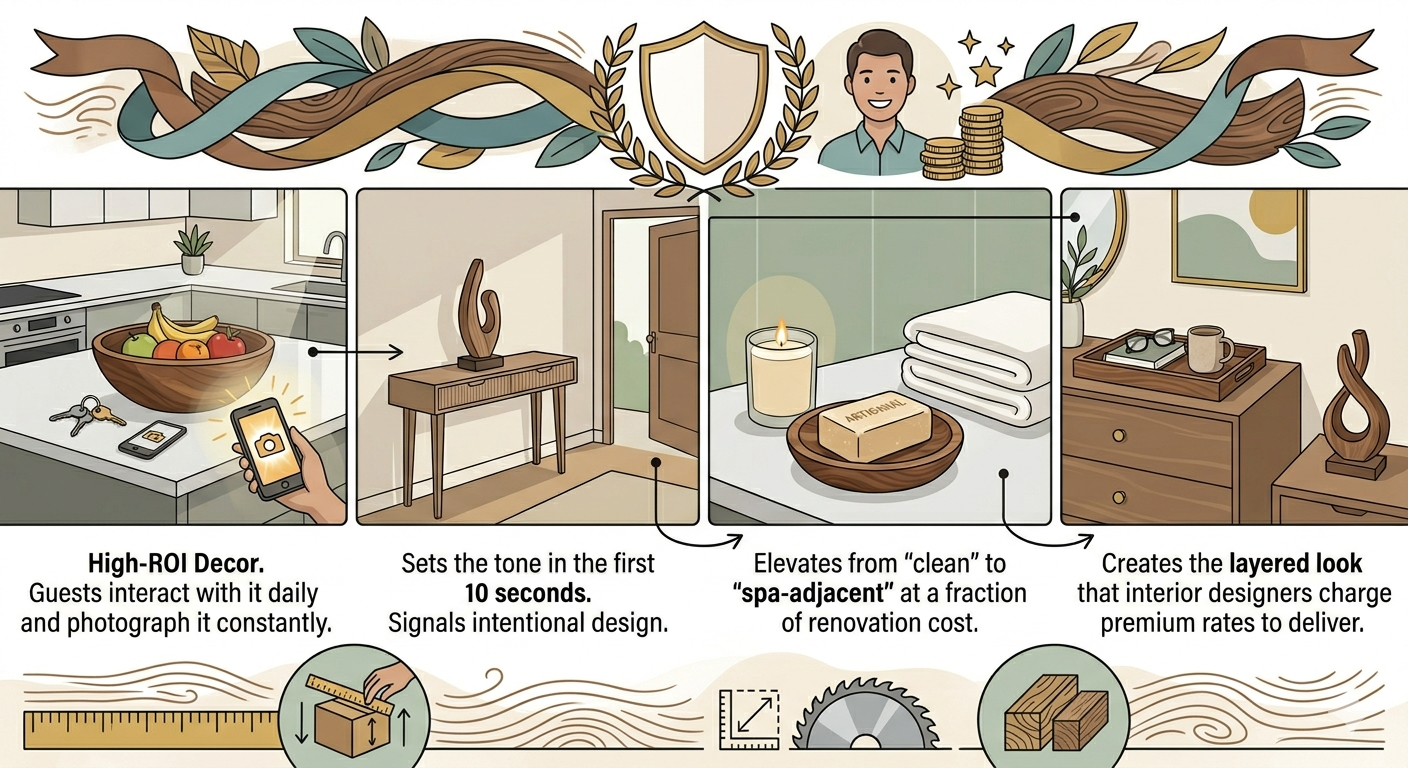
Kitchen anchor piece. A wooden bowl on a counter or island becomes the natural landing spot for everything from fruit to keys. Guests interact with it daily and photograph it constantly. It’s the single highest-ROI décor item per dollar in almost any kitchen.
Entry statement. A small carved sculpture or decorative piece near the entrance sets a tone for the entire property within the first ten seconds. It signals that someone thought carefully about this space.
Bathroom detail. A small hand-turned wood dish for soap or candles elevates a bathroom from “clean” to “spa-adjacent” at a fraction of the cost of renovation.
Bedroom texturing. A wooden tray on a dresser, a sculptural piece on a nightstand — these create the layered look that interior designers charge premium rates to deliver.
The custom order option is particularly valuable here. Hosts who want pieces sized to their specific counters, or who want a consistent wood species across multiple properties, can request exactly that. It’s a level of curation that mass-market retail simply can’t offer.
The Research Phase: Finding the Right Pieces Without Destroying Your Inbox
Most hosts discover artisan makers the same way: deep dives through Pinterest, Instagram, Etsy, and craft marketplace newsletters. The research phase is genuinely enjoyable but comes with a practical annoyance — every discovery requires an email signup for discounts, newsletters, or custom order waitlists, and within two weeks your inbox is a disaster.
A simple habit that experienced online shoppers use: for one-time signups or exploratory newsletter subscriptions you’re not sure you want long-term, use a disposable temporary email to keep your primary inbox clean during the research phase. Once you’ve made your decision and placed an order, you switch to your real address for order tracking and communication. It keeps the discovery phase organized without cluttering your main inbox with promotional emails from a dozen sellers you browsed once.
For ongoing relationships with craftspeople you actually buy from — like a custom order workshop where you want to stay informed about new pieces or seasonal availability — your real email is obviously the right choice. But the research phase doesn’t need to live in your primary inbox.
Starting a Property Brand? The Launch Checklist Nobody Gives You
A growing number of hosts with multiple properties are building actual brands around their listings — a named property experience, a design aesthetic, a consistent identity across units. It’s smart business: branded properties command higher nightly rates, earn more direct bookings, and build a reputation that survives algorithm changes.
If you’re at the stage of formalizing your rental brand, a few foundational steps matter early. Choosing a name that’s distinct enough to be memorable — and checking how many similar property names or hospitality brands already exist — saves painful rebranding later. Tools like howmanysimilar let you analyze name uniqueness against existing businesses before you commit to signage, domain registration, or social handles.
Once you’ve launched a property website (which every serious host should have for direct bookings), getting it indexed properly matters. Generating a sitemap and submitting it to Google is the foundational step — mysitemaps makes this straightforward even if you’re not technical. Without a sitemap, your site can sit invisible to search engines for months while you wonder why direct bookings aren’t materializing.
The Review Math
Here’s the practical calculation. A handcrafted wooden bowl from an artisan workshop costs roughly $80–$200. A single additional 5-star review, depending on your market, can shift your listing position enough to generate hundreds of dollars in additional monthly bookings over the year. The ROI on authentic, photographable décor is real — and it compounds because unlike a mattress topper or a faster router, a beautiful wood piece doesn’t wear out or become obsolete.
It also doesn’t expire. A piece from Carvings By Pelosi that’s in your rental today will still be there in ten years, still earning its place in guest photographs and review mentions, still signaling that someone chose this space with care.
Where to Start
If you’re a host looking to add one piece to a property, start with the kitchen. A turned walnut or cherry wood bowl on the counter is the single highest-impact, lowest-cost change you can make to how a space photographs and feels on arrival.
If you want something more tailored — sized for a specific surface, made from a specific species, or designed with your property’s color palette in mind — the custom work option at Carvings By Pelosi handles exactly that. The process starts with a simple conversation and ends with a piece that becomes a permanent part of your property’s identity.
That’s a different category of investment than a throw pillow. And your reviews will reflect it.