 Every year, HR managers and procurement teams across America face the same problem around Q4: they need to find gifts that feel meaningful without looking like they bulk-ordered from a warehouse. The usual options — wine bottles, generic gift cards, branded mugs — have become so predictable that recipients often don’t even photograph them. They disappear into desk drawers, or worse, into donation bins.
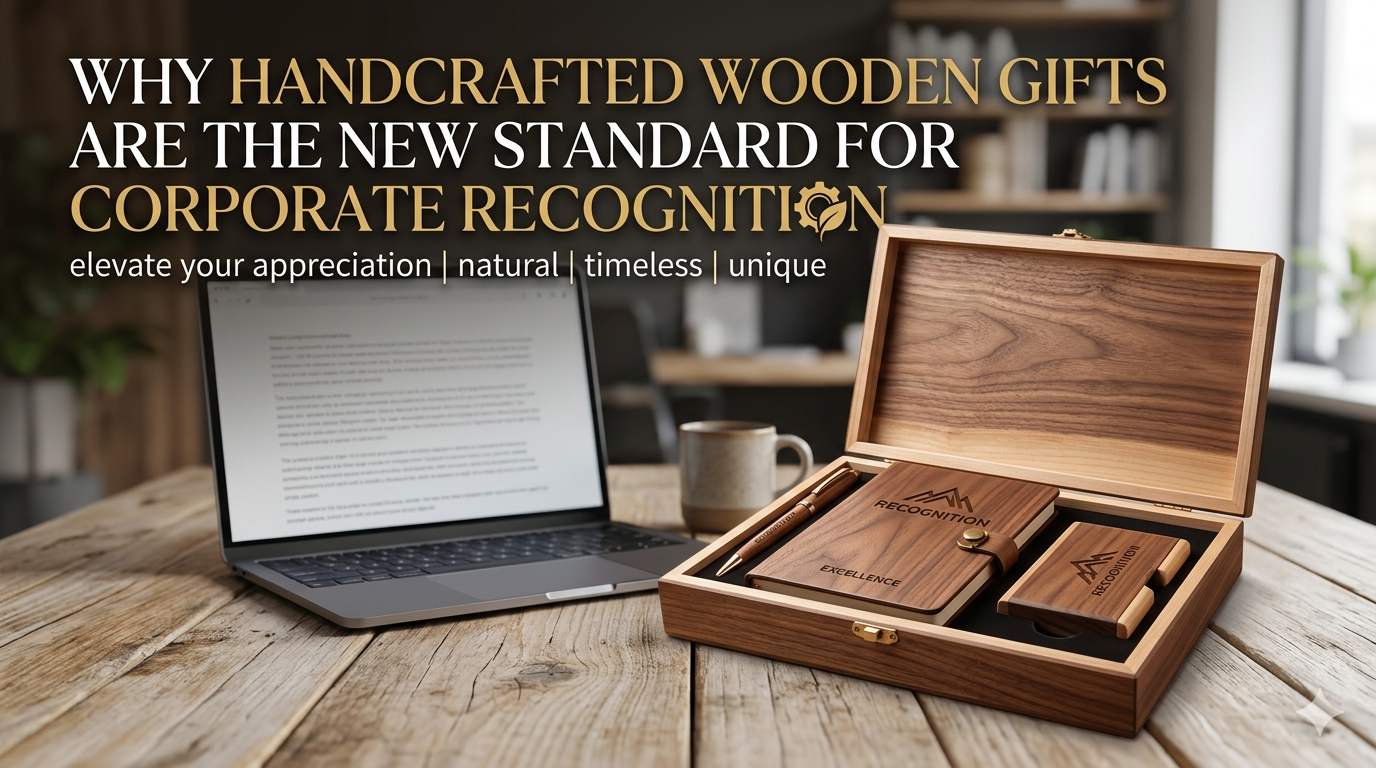
Something has shifted in the last few years. Companies that used to spend $50 on a branded tumbler are now spending $150–$300 on handcrafted wooden pieces — and they’re getting more mileage out of that investment than any logo-stamped product could ever deliver. If you’re responsible for employee recognition, client appreciation, or executive farewell gifts, here’s why artisan wood is becoming the go-to choice — and how to actually order it without the headaches.
The Problem With “Corporate” Gifting
The fundamental failure of most corporate gifts is that they communicate scale, not care. When an employee receives something that clearly came out of a bulk order of 500 identical items, it signals exactly that — you are one of 500. The gift becomes an artifact of process, not recognition.
Handcrafted wooden items operate on a completely different psychological register. A bowl turned on a lathe from a single piece of black walnut, with its natural grain running in a pattern that will never repeat, is by definition one-of-a-kind. When someone receives it, they understand — without being told — that someone chose this piece, not a batch. That distinction matters enormously for things like retirement gifts, milestone recognition, and high-value client appreciation.
John Pelosi, who has been turning wood into functional art since 2001 at his Wake Forest, NC workshop, puts it plainly: the material itself carries the message. The wood’s texture, weight, and grain pattern are things you can’t fake or manufacture at scale. That’s what makes it powerful as a gift.
The Hidden Segment Companies Are Missing
Most wooden craft businesses market to home décor buyers, wedding couples, and individual collectors. Smart procurement managers are discovering that artisan wood pieces solve a very specific corporate problem that no amount of branded merchandise can: the differentiation gap.
Think about the moments that actually matter in corporate culture — a 20-year anniversary, a regional VP stepping down after a decade of growth, a client who just renewed a seven-figure contract. Generic gifts don’t just fall flat in these moments; they can actually cause mild offense by signaling that the company couldn’t be bothered to think harder.
A handcrafted piece with the company’s founding year carved into the base, or a custom wood sculpture sized to sit on a C-suite desk, does the opposite. It becomes a conversation piece. It gets photographed. It gets displayed. And critically, it associates your brand with craftsmanship — a value most companies say they have but rarely demonstrate.
Corporate buyers are also discovering the custom order model at places like Carvings By Pelosi, where a bulk request for 20 matching pieces — or 20 intentionally distinct pieces from the same wood species — can be fulfilled with a level of personalization that no factory can match.
How the Ordering Process Actually Works
One thing that surprises first-time corporate buyers is how straightforward the custom process is compared to what they expect. It’s not months of back-and-forth. For most orders, it starts with a conversation about the occasion, the recipient, the wood preference if any, and any custom engraving or sizing requirements.
Where companies sometimes create friction for themselves is in the contact collection phase. When HR teams try to gather employee preferences or gift recipient information via survey forms and email campaigns, they often collect a surprising number of invalid or temporary email addresses. This is a known issue in B2B workflows — people filling out internal preference surveys sometimes use throwaway inboxes, especially if they think the form will lead to marketing emails. The result is that custom quote follow-ups never reach the right person.
The practical fix is simple: before sending custom order consultations or quote emails to a collected list, run a quick verification pass. Filtering out disposable or invalid addresses — the kind generated by temporary email services that exist for one-time signups — means your follow-up actually lands. It’s a five-minute step that prevents weeks of silence from “interested” recipients who you can no longer reach.
For teams ordering directly for named recipients (which is best practice for executive-level gifts), this isn’t an issue — you’re going direct. But for larger all-hands recognition programs where preferences were collected via form, it’s worth knowing.
What Makes Wood the Right Material Right Now
There’s a broader cultural current running under this trend. Consumers and employees alike have developed a fatigue with things that feel synthetic, disposable, or algorithmically generated. There’s a genuine appetite for objects that carry evidence of human skill — not nostalgia, exactly, but a recognition that some things are better made by hand.
Handcrafted wood fits this moment precisely. It’s sustainable in a way that resonates with company ESG narratives. It ages visibly and beautifully, unlike most manufactured goods. And it carries provenance — you can say “this was made by hand in North Carolina” and that sentence means something.
For companies that have already made commitments to supporting small American businesses or buying local, sourcing corporate gifts from artisans like Carvings By Pelosi also makes for a genuine internal communications story. It’s not virtue signaling when you can point to a specific craftsperson, a specific workshop, and a specific technique.
Getting Started With a Custom Order
If you’re approaching this for the first time, here’s a simple framework:
Occasion-first thinking. What is the gift actually marking? A retirement deserves something permanent — a sculpture or a large decorative bowl. A client milestone might call for something functional — a serving board with their company name, or a pen holder for a home office. Matching the object’s use to the occasion’s meaning matters.
Wood selection. If you want input, ask. The craftsperson’s knowledge of which species carry which visual weight and character is itself worth consulting. Black walnut reads dark and serious. Maple is light and modern. Cherry deepens with age. These aren’t arbitrary — they contribute to how the gift is received.
Lead time. Custom work takes time, and the best artisans fill up. For Q4 gifting, conversations should begin by September. For individual milestone gifts, two to four weeks is usually sufficient.
Custom Orders Are Welcome at Carvings By Pelosi — the process starts simply with a message and a brief about what you’re looking for.
The Bottom Line
Corporate gifting is shifting from a branded commodity to a meaningful object. Companies that recognize this are using handcrafted pieces not just as gifts, but as physical expressions of company values. The investment is modest compared to the return in goodwill, display longevity, and recipient memory.
A wine bottle is forgotten by January. A handcrafted walnut bowl is on the credenza for a decade. That’s the calculus that’s changing procurement decisions — and it’s why artisan wood is the quiet winner of the corporate gifting conversation right now.